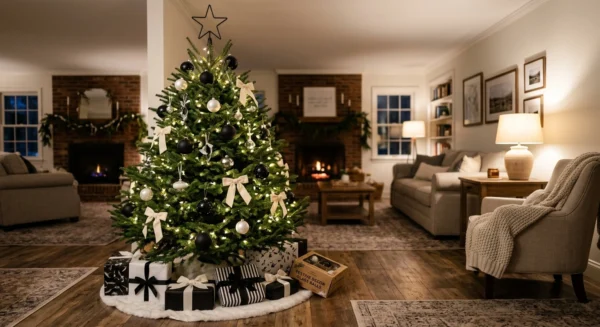
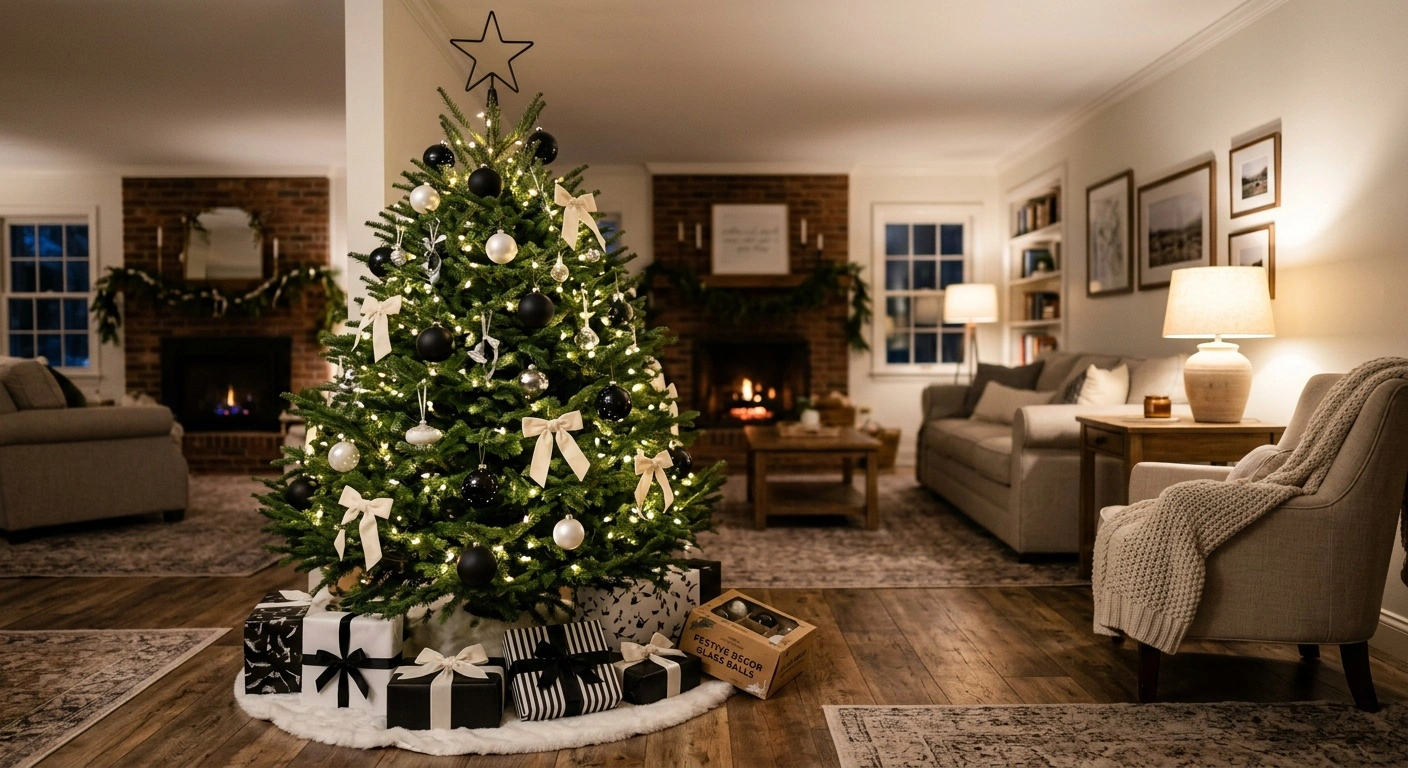
A black and white Christmas tree uses strong contrast to make every decorative layer visible across the room. The palette can look crisp, wintry, warm, or traditional depending on the materials. Matte black ornaments add depth, while pearl, glass, and metallic finishes reflect light.
Avoid treating black and white as two solid blocks of color. Identical ornaments often create a rigid pattern instead of a finished arrangement. Vary the size, texture, and finish, then repeat those details from top to bottom. Warm white lights soften the contrast, while cool white lights produce a sharper, icier look.
Building a Black and White Christmas Tree Color Palette
First, decide which color will dominate. A mostly white tree with black accents feels bright and graphic. A darker arrangement creates a moodier, more tailored effect. On a green tree, white ornaments stand forward while black ornaments recede into the branches.
Mix pure white, ivory, pearl, and frosted glass for a richer result. Black also changes with the finish. Matte black absorbs light, satin black softens reflections, and gloss black adds small points of shine.
If you add a third color, limit it to one supporting material. Silver creates a clean, modern effect, while champagne metal brings warmth. Natural wood makes the palette feel more relaxed. The tree should read as black and white from the doorway but reveal subtle variation up close.
| Palette direction | Main materials | Best light color | Overall effect |
|---|---|---|---|
| Crisp modern | Pure white, matte black, chrome, or silver | Cool white | Sharp, graphic, and minimal |
| Warm modern | Ivory, satin black, and champagne metal | Warm white | Polished without feeling cold |
| Scandinavian-inspired | White felt, black paper, and pale wood | Warm white | Simple, textured, and relaxed |
| Glamorous monochrome | Gloss black, pearl white, clear glass, and silver | Warm or neutral white | Reflective and formal |
Use Ornaments and Texture to Create Depth
Start with ball ornaments in at least three sizes. Large pieces establish the palette, while small ornaments fill narrow spaces. Place the largest ornaments first and tuck several deep into the branches. This technique makes the tree look full instead of surface-decorated.
Use medium ornaments to repeat the main colors throughout the tree. Place smaller pieces near branch tips and in awkward gaps. A practical mix includes matte black, gloss black, opaque white, pearl white, and clear glass.
Texture keeps the limited palette interesting. Try velvet bows, felt shapes, ribbed glass, metal bells, ceramic ornaments, paper stars, or yarn tassels. Stripes, checks, and dots can add movement, but choose one main pattern family.
Thin black ornaments may disappear against deep green needles. Place them near white ribbon, pale ornaments, or open areas where their outlines remain clear.
Choose Lighting That Supports the Look
Warm white LED lights suit most monochrome decorating schemes. They flatter ivory, wood, velvet, and champagne accents. Cool white LEDs brighten pure white ornaments and pair well with silver, chrome, or clear acrylic.
Avoid mixing noticeably warm and cool strands unless you plan that contrast from the start. Run lights near the trunk and along the outer branches. Interior lighting prevents black ornaments from turning into dark gaps.
For a full tree, wrap the trunk area loosely before moving outward. Check your work with the room lights dimmed. The bulbs should look evenly scattered rather than forming bright horizontal bands.
Choose indoor or indoor/outdoor lights with a UL, ETL, or comparable safety listing. Inspect cords for fraying, cracked sockets, and loose connections. Follow the manufacturer’s limit for connected strands, and never staple or nail through wires.
Keep cords away from curtains, paper decorations, and other flammable materials. Turn off the tree before sleeping or leaving home, or use a timer. If you have a real tree, water it daily because dry branches catch fire more easily.
Select a Topper and Tree Skirt With Enough Visual Weight
The topper should repeat a strong shape or material from the tree. A black metal star suits a geometric design. A large white bow works well with velvet ribbon and soft ornaments.
Small toppers can look undersized on full trees. Choose enough width to balance the upper third without bending the central stem. You can also cluster lightweight picks, narrow ribbon tails, and a few ornaments near the top.
At the base, a white faux-fur skirt softens the strong contrast and conceals cords. A black woven or metal collar creates a cleaner outline. However, a dark collar may feel heavy when the lower branches already hold many black ornaments.
Checked fabric adds pattern near the floor without crowding the branches. Keep the base neat and proportional. Leave clear access to the stand, water reservoir, plug, and timer.
Layer the Decorations in the Right Order
Decorating in layers keeps ribbon from crushing ornaments. It also reduces the need to move fragile pieces. Work with the lights on so you can identify empty areas early.
Step back after every major layer. View the tree from the doorway, sofa, and any visible side. You should see an even rhythm of dark and light rather than separate black and white sections.
Perfect symmetry can look stiff, so focus on repetition instead. If you use black velvet ribbon near the top, repeat it through the middle and lower branches. Save delicate ornaments for the final stage.
- Test and install the lights. Start near the trunk, then move outward. Adjust each section until the lighting looks even.
- Add ribbon or garland. Weave it through the branches in loose curves. Avoid tight horizontal bands.
- Place the largest ornaments. Tuck them into sturdy interior branches to create depth from several angles.
- Add medium ornaments. Alternate black, white, and the supporting finish from top to bottom.
- Fill gaps with small ornaments. Use them at branch tips and in narrow openings without crowding the needles.
- Add textured and patterned accents. Repeat bows, bells, or paper shapes at measured intervals.
- Attach the topper. Fasten it to the central stem and check that it sits straight.
- Finish the base. Arrange the skirt or collar without pinching cords or blocking the water reservoir.
Black and White Christmas Tree Ideas for Different Styles
For a minimal design, use matte white ornaments with fewer black geometric pieces. Add thin black ribbon and a plain metal star. Leave open space between decorations so each shape remains distinct.
For a softer style, combine ivory ornaments, black velvet bows, white felt, and pale wooden beads. Warm white lights will support the natural materials. This combination works especially well on a green tree.
A formal design can include pearl white, gloss black, clear glass, silver beads, and reflective picks. Use glitter in small, repeated amounts. Too much sparkle can blur the clean color scheme.
For a playful family tree, choose stripes, dots, checks, homemade paper ornaments, and oversized bows. Repeat only two or three patterns to keep the arrangement organized.
On a flocked tree, use more black because white ornaments may disappear against the artificial snow. Reverse the balance on a white artificial tree. Make black the main ornament color, then use white for texture and shine.
Shopping List With Budget-Friendly Alternatives
You do not need to replace your entire ornament collection. Existing silver, clear, wood, and neutral decorations can support the palette. Sort what you own by color and finish before shopping.
Buy the most visible pieces first. Ribbon, large ornaments, and a topper establish the design faster than small fillers. Count dark ornaments before hanging them, and inspect each cap or loop.
Choose wired ribbon when you want structured curves and loops. It holds its shape better than soft fabric. The following list covers each decorative layer and includes a lower-cost alternative.
- Lights: Choose warm white or cool white LED strands. Budget option: Reuse a safe, working strand with one consistent color temperature.
- Base ornaments: Use black and white balls in several sizes and finishes. Budget option: Add ribbon ties, paper bands, or removable fabric wraps to neutral ornaments.
- Ribbon or garland: Try black velvet, white satin, striped ribbon, wooden beads, or metallic garland. DIY option: Cut clean cotton fabric into strips and tie loose bows.
- Textured accents: Add felt ornaments, ceramic shapes, metal bells, yarn tassels, or faux snowballs. DIY option: Cut stars and circles from felt or heavy paper.
- Patterned ornaments: Choose a small set of stripes, checks, dots, or geometric designs. DIY option: Paint simple lines on plain craft ornaments and let them dry fully.
- Topper: Use a black star, white bow, clustered picks, or lightweight wire shape. DIY option: Form a star from craft wire or stiff card.
- Tree skirt or collar: Choose faux fur, woven material, checked fabric, or a metal collar. Budget option: Fold a clean blanket or sturdy fabric around the stand.
- Hooks and ties: Use ornament hooks, green floral wire, or reusable soft ties. Budget option: Substitute narrow ribbon or cotton thread.
Keep fabric and paper away from bulbs and electrical connections. Never drive staples through light wires or branches. Make sure plugs and the water reservoir remain easy to reach.
Make the Tree Fit the Rest of the Room
A high-contrast tree looks more cohesive when nearby decorations repeat its palette sparingly. Carry black and white into a few gift wraps, stockings, cushions, or mantel accents. Avoid covering every surface with the same pattern.
Evergreen wreaths and garlands can serve as a natural third color. A small amount of cranberry red adds traditional warmth. If the room has dark furniture, use more white ornaments so the tree remains distinct.
In a pale room, black ribbon and ornaments may provide enough definition on their own. Wrap gifts in mostly solid paper with one patterned ribbon. This keeps the base from looking cluttered.
Route cords along the wall or under a proper cord cover. Keep them away from walkways whenever possible. Never run cords beneath rugs, where heat and damage can go unnoticed.
Finish the Tree Without Overfilling It
The best black and white Christmas tree shows visible branches, balanced contrast, and varied texture. If the design looks flat, add another finish before introducing another color. If it looks busy, remove one pattern family.
Take a photograph with the room lights dimmed. A photo often reveals dark patches that are difficult to notice up close. Move a few ornaments before adding a new decorative layer.
Finally, place heavy pieces on sturdy branches and close every hook. Keep breakable ornaments away from young children and pets. Turn off the lights before bed or when leaving home, and check a real tree’s water level daily.